Should you wash heavy equipment before winter storage?
Yes. Wash a machine before it gets parked for the winter, let it dry, then grease it. Mud and salt left on over the winter hold moisture against the steel for months, hide the leaks and cracks you want to find now, and can freeze the undercarriage solid.
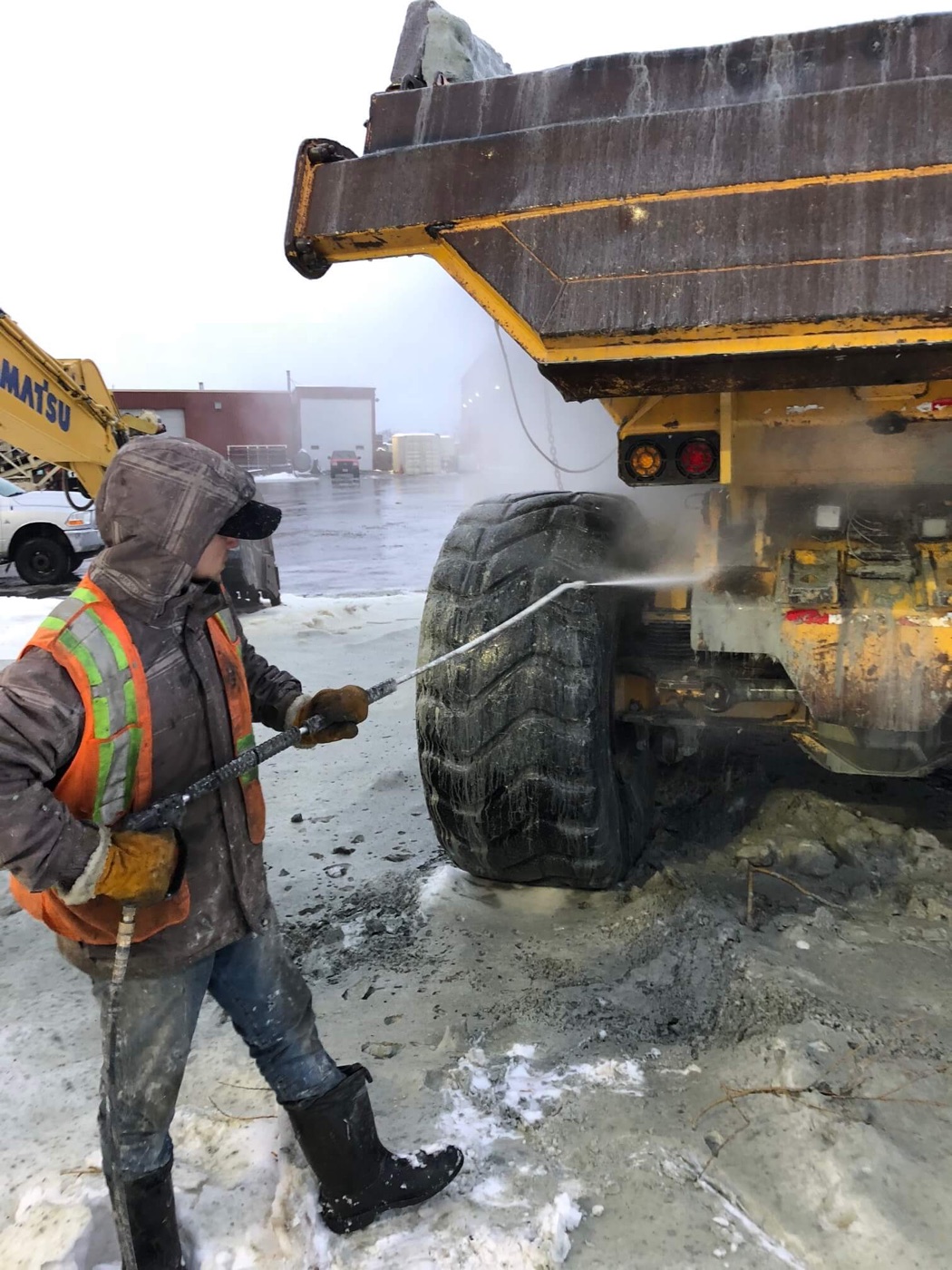
Late fall is when a lot of equipment in Nova Scotia gets parked. Road builds wind down, sites close for the season, and machines go to the back of the yard until spring. Most of them go there exactly as they came off the job, packed with mud. That is the most expensive way to store a machine.
Why wash heavy equipment before storing it?
Because dirt holds water. Packed mud and clay in the tracks, the belly pan and the frame stay damp all winter, right against the steel. Anything that worked near salted roads this fall is carrying salt in that mud too. Months of that is how pins, brackets and the lower frame rust while the machine sits doing nothing.
The other reasons are all about spring:
- You can see what needs fixing. Cracks in the boom, weeping cylinders, leaking hoses and worn teeth hide under a layer of mud. Find them in November and the parts are on the shelf before the season starts, not on the first day back.
- The undercarriage does not freeze solid. Wet mud packed into tracks, rollers and idlers freezes hard. Moving a machine that has sat all winter in frozen muck is rough on the tracks and the drive.
- Less risk of fire and mice. Dry debris packed around the engine and exhaust is a fire risk when the machine fires up again. A dirty machine parked for months also gives mice somewhere to nest and wiring to chew.
What should you clean first?
Start with the parts that cost the most when they go wrong:
- Undercarriage, tracks, rollers and idlers, or tires and wheel wells, where the mud packs hardest
- Belly pan and lower frame, where water and salt sit
- Around pins, bushings, cylinders and fittings, so you can see leaks and grease properly
- Engine compartment debris, gently, staying off the electrical parts
- Radiator and cooler fins, at low pressure and straight on, so the fins do not fold over
- Glass, lights, mirrors, steps and handholds, so the machine is safe to run when it comes back out
What should you not pressure wash on a machine?
Keep high pressure off anything water can be forced into. That means electrical connectors and control boxes, gauges and cab controls, seals on cylinders and swing bearings, air intakes and breathers, and radiator fins up close. Water driven past a seal does not come back out on its own, and it is still in there when the temperature drops.
It is the same rule we use on everything we wash: pressure where the surface can take it, care where it cannot. Packed clay on a track frame gets everything the machine has. A wiring harness does not.
Do you need to grease equipment after washing it?
Yes. Washing pushes water into pin joints and flushes out some of the old grease. Greasing every point once the machine has drained pushes that water back out and leaves fresh grease in the joint for the winter. Your service manual has the full list of grease points and the rest of what the manufacturer wants done before storage, like fluids, batteries and fuel.
How cold is too cold to pressure wash equipment?
It is too cold when the water freezes on the machine before it can drain off. Below freezing you end up with ice in the tracks, on the steps and in places it should never be. Wash on a day above freezing, early enough that the machine drains and dries before night. Then park it on gravel, planks or a pad rather than in mud, so the tracks or tires do not freeze to the ground.
In Nova Scotia that window gets narrow from late November on. If a machine is going to sit for the winter, the time to wash it is before the hard freezes settle in, not after.
Machines that work all winter
Loaders, plow trucks and spreaders are the other way around. They spend the winter in salt and slush, so they want a wash or two during the season and a proper one the week the season ends, before the salt gets all spring to work. The same goes for any truck hauling on salted roads. Our post on washing trucks in a Nova Scotia winter covers that side.
Washed where it sits
An excavator is not driving across the province to get cleaned, and a site shutting down for the winter often has no water on. That is why we work the way we do. We are a mobile wash and we bring our own water on the truck. We wash excavators, loaders, dozers and haul trucks where they are parked, at the pit, the quarry, the yard or the job site, anywhere in Nova Scotia.
The products we use are environmentally safe and will not harm plants, grass or animals, which matters on a site that drains to a ditch or a brook. We carry insurance and WCB coverage, and if your site needs paperwork on file before anyone comes through the gate, we will send it. We have been doing this since 1997.
Tell us how many machines, what they are and where they are parked through our quote page. There is more on how we work on our heavy equipment washing page, and if there are trucks in the same yard, fleet washing can be done on the same visit.